Elizabeth (Eliza) Catherine Prior, nee Skynner
Thomas and Elizabeth (Eliza) Catherine Skynner (17951) -1863) were married at Cookham, Berkshire, England by Cookham's long-term Anglican vicar, the Rev. Richard Whately, on 31 December 1818. Eliza had grown up in Cookham, at her family's home Moor Hall. Perhaps because Thomas had two very young daughters to care for, the marriage took place a little over a year after his first wife died. The year of their marriage is confirmed by a silver case 2) with an inscription on it that it was given to Colonel Prior by his wife Eliza Skynner on their marriage in 1818. The details of the marriage were also provided by TLM-P to the College of Heralds.3) As noted elsewhere, despite Thomas' financial fecklessness, the marriage appears to have been a happy one, with all the children enjoying a loving relationship.
A likely contribution to their marital happiness was that Eliza had her own income controlled by trustees appointed by her mother's family the Orlebars. Without such a settlement, all her assets would automatically go to her husband. Eliza's mother had a substantial marriage settlement and the Orlebars ensured that Eliza had one too (possibly under the terms of her mother's marriage settlement). Eliza's trustees were Richard Orlebar (most likely her uncle Richard who lived 1775-1833) and a Richard Smith (most likely the family's solicitor), with Lodge Morris Prior involved, perhaps as a witness.4) Under the terms of her marriage settlement, Eliza owned (under the control of her trustees) “one third of the leasehold messuages [household with its surrounding land and buildings] and East India stock [shares]… one third of the leasehold assigned and 3533 of East India stock transferred to … upon Trust.” The East_India_Company was a huge global business which was noted for its (very profitable) rapaciousness - its trade included enslaved peoples and its single-minded greed in India resulted in famines including the Great Bengal Famine of 1770, during which 10 million people starved to death. At the time Eliza and Thomas married, the East India Company was a 'blue-chip' investment because of its influence on the British government which consequently tied its dividends to the company's monopoly, ensuring reliable and very profitable returns.
Eliza Prior died on 18 November 1863.5) Her stepdaughter Jemima wrote immediately to TLM-P, saying that his mother had died from heart disease, with her husband by her side. He would, Jemima wrote to TLM-P. 'feel her loss deeply' after being married so long.6) That letter, in an envelope with a black border, took over two months to reach TLM-P.7) Eliza had been ill for some time, and prepared for death. TLM-P wrote, that 'if ever there was faith and hope on earth it was in her, may we follow her steps.'8)
Eliza's mother Mary Skynner
Eliza's parents were William Augustus Skynner9) and Mary Skynner nee Orlebar (1768-97). They married in 1790.10) More information is in the Bedfordshire Archives, in the documents used by Frederica St. John Orlebar to compile The Orlebar Chronicles in Bedfordshire and Northamptonshire, 1553-1733, a detailed genealogical and historical work chronicling the lives, letters, and estate records of the Orlebar family. Elsewhere, the archives comment that “The Orlebars, who owned Hinwick, wrote a lot of poetry and Mary Orlebar was extremely prolific with her pen – the first volume we have of her poems has the contemporary label 'volume 41'.”11)For a listing of the contents of the extensive Orlebar family Archives, see https://discovery.nationalarchives.gov.uk/details/r/1cdebd53-81bf-4155-8842-64349f38106d. Sadly some revealing poems by Mary Orlebar were not purchased but initially catalogued. For more information see 12)
 13) This is an elegant, classically inspired mourning ring, worn to indicate (along with the strict wearing of black) the recent death of a loved one. The black enamel underneath one side of the urn is chipped, showing the gold underneath. The writing above the centre funeral urn states ‘Mary Skynner OB [who died]'. The writing below the urn gives her date of death '14 Nov 1797’ and age (AE) 29. Mary was buried in the family vault in the churchyard of the Church of England St Gregory by St Paul, on 22 November 1797.14).
The Bedfordshire Archives collection includes three letters from Mary Skynner to her 'Dearest Brother' Richard Orlebar, two in 1795 and one (a page added to her husband's letter, in 179715)and a letter from Mrs Catherine Jones to Mary's sister Anne Orlebar after Mary's death in 1797.16)
Mary's letters have a light-hearted tone, as well as revealing her love and concern for her 'Dear Brother' (initially Lieutenant in the Bedfordshire Militia) Richard Orlebar and her delight in her three young daughters. The first of her letters was written on 14-26 June 1795. It was the second letter she'd written since the birth of her third daughter (Eliza). The first was to her aunt Eliza who had been with her for the birth. She reassures Richard that both know they are loved by the other: 'My Dearest Brother’s hand writing always gives me the truest pleasure, though I can not help complaining that it does not more frequently greet My Eyes, however we both plead guilty as idle Correspondents, and as we are both very certain of each others Sentiments, Excuses will not be requir’d from either.' She mentioned that, on her 5th wedding anniversary, 'My Dear Babe'(Eliza) was baptised. The godparents were Aunt Eliza and Mrs [Catherine] Jones. Her two older daughters 'are both very entertaining'.
Mary Skynner's second letter was written on 15 August 1795, and is also to her 'Dear Brother' Richard, newly promoted to Captain. In it she describes her three young children with loving complacency: 'Maria as usual my constant Companion, & is as tall as most Children of five years old, therefore not yet very fat, Harriet Sydney [why Sydney I wonder?] runs & talks very fast, she gets a great many admirers, she is so pretty & good humor’d, My little Eliza Catherine [a baby still] seems at present to take after her.' In it she urges her brother to visit their grandfather who lives about 4 miles from his military camp 'quite within the limits of a Walk'. She also urges him to marry for love as well as material considerations: 'mind the old saying that when Poverty comes in at the Door love flies out at the Window & yet believe Me, I would not have you consider Riches alone for that will never do! So My Dear Rich’d: with wishing you ever as much happiness & comfort as can fall to the Lot of a Mortal & Mr Skynners kind Regards I remain/ Your truly Affecte. Sister M. Skynner'. Note that it was usual for women to refer to their husbands formally ('Mr Skynner') and that signatures were consistent whether a loving family or business letter ('M. Skynner').
The next letter was from William Skynner, on 17 February 1797, in a more serious tone writing to Richard that his wife Mary, Richard's sister, much wishes to see him. He also refers to Richard's debts, admonishing him not to get in debt again. Mary was expecting her fourth child around the end of February or early March. She was, William write, tolerably well (meaning not completely well). Perhaps to soften his stern advice to Richard to curb his expensive lifestyle, William mentioned that they were happy that Richard would be the expected baby's godfather. It is not known if this baby survived. In her letter Mary expected him to escort 'our dear Anne' (their sister) to visit them.
The next letter is from Catherine Jones to Anne Orlebar, on 3 December 1797. Mary, as the mourning ring indicates, had died some 9 months after she expected to give birth. Birth was then hazardous with around one birthing woman for every 200-250, dying as a result. It was not helped by the frequency of births - Mary, for example, had 4 births in 7 years of marriage. She survived, but it is not known if she was weakened in the process. Catherine Jones' letter refers to Mary and her family moving to a new house and asks 'do you think her cold was caught from that?' Did she catch a cold which then resulted in a lung infection which killed her? In any case, her husband was 'much afflicted' which Catherine Jones thought, showed he valued 'the Treasure he has lost', his wife. She also mentioned how Mrs Orlebar, presumably Mary's mother, insisting her grandchildren all go into mourning. The three little children in black 'sickened' her to her heart.
Mary Skynner was not forgotten. The Bedfordshire Archives noted the existence of poems written by her aunt Mary Orlebar (1730-1821)17) One of Mary Orlebar's poems was written on 29 December 1819 to celebrate her 89th birthday. Another poem (item 133) is about her namesake: 'On Contemplating the picture of my beloved niece Mary Skynner, some years after her death'. It would be wonderful to discover the whereabouts of these poems. The Bedfordshire archives also has this miniature portrait thought to be Mary Skynner in c.1797: They also have a photo of a painting of Mary Skynner but unfortunately it is not available online.18)
In his 1882 diary, TLM-P recalls when on a trip between Uxbridge (now in west London) and Amersham, it was near where 'Uncle Augustus Skynner was taking us to [Birds?]'(19 August).19) In May-June 1882, TLM-P visited the Orlebar family at Hinwick House, Bedfordshire (at time of writing, it had become a luxurious hotel). It was at a sad time: the current Orlebar (a little man 'ferretty with red hair') had been doing what 'he could to retrieve what his father had done but heavy interest on mortgages, bad seasons one after another, rents unpaid etc., so with all their striving has failed and now they have to shut up the House and leave.' Though the Orlebars had two 'steady' sons in professions, Mr Orlebar had only an agency which would bring in £100 p.a. income. TLM-P thought that it would need an income of £20,000 p.a. to maintain Hinwick House. Among the portraits owned by the Orlebars was one of Eliza's Orlebar grandfather, 'nothing like the miniature of my Grandfather, W.A. Skynner who married his daughter Mary O[rlebar]'. He also mentioned that nearby Pollington Church contained the graves of his maternal ancestors.20) TLM-P was sufficiently impressed with this past grandeur that, two years later, he named his youngest son Julius Orlebar M-P.
Portraits of Eliza Skynner (later Prior)
 This sketch of 'Miss E. Skynner, Moor Hall Berks 1816' is by an unknown artist.21)
 In the bottom right hand corner, is the faint name, E. Prior.
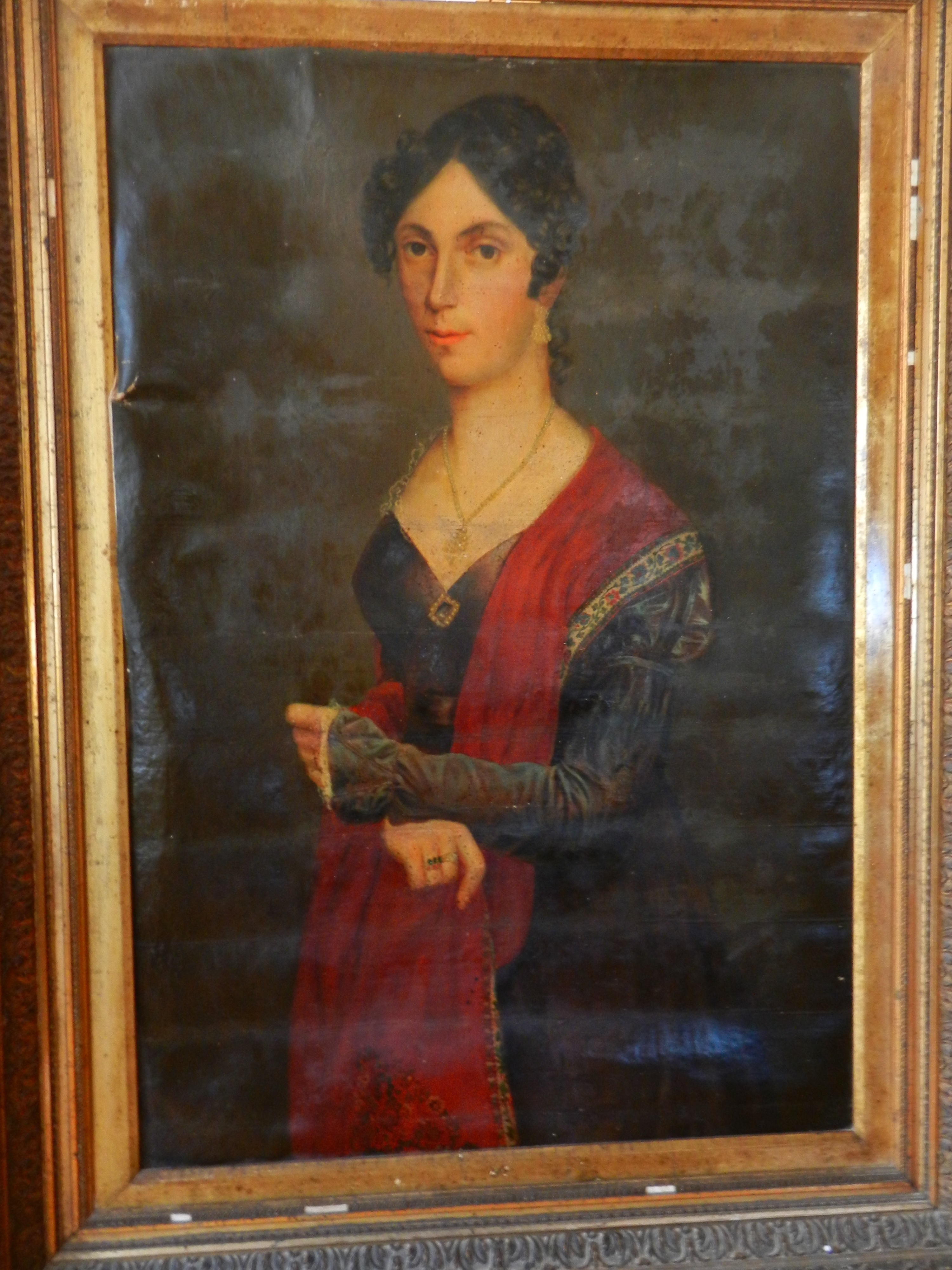 This painting is unidentified but, given the similarity with the unfinished sketch of a girl (shown ?) is probably by William M-P. Given her age and dress, it is possibly Eliza Prior. It is likely to be the painting mentioned in TLM-P's will - of his mother by W.A.M. Prior.22)
For more of Eliza Prior's art, see Thomas Prior's album. You will see that this album begins with her son William's art but then (after his death?) other art have been added, including some by Eliza Skynner/Prior. There are also a number of beautiful paintings of flowers, sadly unsigned by the context suggests they are by Eliza. The family had two loose paintings of flowers in a similar style but a bit too large to fit in the album. They are on thick, discoloured paper with dirt marks on them, but still beautiful - 
 23)
Religious faith
Evidence of Eliza Prior's strong religious nature comes from the books which she owned. Almost all of them are religious ones, with a strong evangelical flavour.24) 1. Collected works of Bishop Joseph Hall, published in 1617. The works include Hall’s uncompromising anti-Catholic tract with a title that leaves no room for misinterpretation!: 'No Peace with Rome. Wherein is proved, that (as termes now stand) there can be no reconciliation of the Reformed Religion, with the Romish (and that the Romanists are in all the fault)'. It also includes his still-popular 'Meditations and Vowes, Divine & Morall [Moral]: Serving For Direction in Christian and ciuill [civil] practise'. Eliza was 26 years old when she was given this book, with the following dedication:
John Green & Maria Ethelreda Bishop to their beloved Sister Eliza Prior greeting – May the Lord bless the Perusal of their volume which is full of comfort, experience, and instruction. April 25, 1821.
This inscription reads like a Bishop’s greeting to a ‘sister’ in Christ, while the names suggest a couple with the surname Bishop: another mystery that needs further research.
2. The Saints’ Everlasting Rest; or, a Treatise of The Blessed State of the Saints in their Enjoyment of God in Heaven, published 1814 and given to her by the Rev. G. Valpy.
3. Physico-Theology: or, a demonstration of the Being and Attributes of God … by W. Derham, Eliza wrote in it that it was ‘Bought at the sale of Mr Nelson’s Books late secretary to Mr[?] Rob: Walpole & Fell: of Kings coll: Camb: [ie. Fellow of Kings College, Cambridge University]'.
4. A Connected View of some of the Scriptural Evidence of the Redeemer's Speedy Personal Return …by James Begg, 3rd Edn., 1831, with the inscription ‘E. Prior 1831’.
5. Theron and Aspasio, another evangelical book that remains popular today. It had a major impact on Eliza, as seen by her writing inside it:
Eliza Prior. This book she has found a treasure indeed, as it easily convinced her, that Christ was all. May her dear children read it with attention, and may they be led by the influence of the Holy Spirit to take Christ as their portion, and to say that they “count all things but less for the excellency of the knowledge of Christ Jesus their Lord.
6. The Titles of Christ viewed Prophetically: Being Lectures delivered during Lent, 1857 … by Twelve Clergymen of the Church of England, London: John Farquhar Shaw, 1857. In it is written 'Mrs Prior; Southsea August 31st 1857.'
7. The Gospel-Mystery of Sanctification … Suited especially to the cases of those who labour under the GUILT and POWER of IN-DWELLING SIN. To which are added, A Sermon on JUSTIFICATION… by Walter Marshall, London, Joseph Johnson, 1765. The name written in it is simply 'Eliza –'.
8. Issac Watts, Logick: or, the right Use of Reason in the Inquiry after Truth, with a variety of rules to guard against error in the affairs of religion and human life, as well as in the sciences, Charles Elliot: Edinburgh, 1781.
There is also a book of sketches of Bruges presented to 'Mrs Prior from Mrs Longdon, Bruges, April 26th 1843'.25) Another book, an ornately bound Bible produced by the evangelical Society for Promoting Christian Knowledge, was given by Eliza Prior to her husband as a birthday present, not neglecting to add a bit of proselytising when she wrote in it:
Lieutenant Colonel Thomas Murray Prior From his affectionate Wife - August 1st 185626) “Being heirs together of the grace of life”, may we be joint Partakers of that Kingdom which Christ is preparing for His faithful Followers. “being justified by faith we have peace with God through our Lord Jesus Christ - Rom V - 1. Mark the perfect Man, and behold the upright - for the end of that man is Peace. Ps xxxvii.v.37.
Eliza Prior remained a committed Christian, as shown by her gifts to her son TLM-P. One was The Churchman’s Monthly Penny Magazine and Guide to Christian Truth, vol IV, June 1849-December, 1850. She wrote in it: ‘T.L.M. Prior from his affectionate Parents. August 1851. The Lord lift up his countenance upon you and bless you and may His Love reign in your heart for evermore.' A second book gift to her son was made in the year of her death. It was Bishop Colenso and the Pentatench or, The Bible in the Gospels. A vindication of the Historical Character of the Old Testament27) The book is still being sold to those eager for its affirmation of the literal truth of the Bible. This copy is inscribed 'T.L. Murray and Matilda Prior from their affectionate Mother. February 17th 1863.' She followed with a Biblical quote stating that 'All Scripture is given by inspiration of God … That the man of God may be perfect, thoroughly furnished unto all good works'.
Eliza absorbed the church's general injunction of the time that women should be self-sacrificial. Certainly, when faced with a spendthrift husband whose career was curtailed by peace, and four children to support, she had little choice. When recalling his emigration to Australia, TLM-P acknowledged his mother's sacrifice to help him, writing that:
'Mother … [gave me all the money] she could possibly spare from their modest allowance and made me take the few sovereigns which would diminish home comforts for the quarter [til next payday]'.28)